We continue our journey through the alternative reality of Joss Sheldon. Having established his historical and demographic blindness at the airport, Sheldon now moves inland, deeper into the West Bank, where his inner „Mauer im Kopf“ (the wall in his own mind) completely takes over.
Let’s look at how he frames the essential security infrastructure of a state under siege:
“The Wall is, if nothing else, a reminder to the Palestinians that the Zionists are in charge. It is not the only reminder they face on a daily basis. Checkpoints are everywhere, and though most are not operational or even efficient (I am sure any real ‚terrorist‘ could easily find a way around most checkpoints), their mere existence serves to remind the population that they can be stopped, searched, delayed, arrested or harassed at any time. And the locals are harassed at checkpoints. In the most extreme cases, they are forced to sit for hours in the sun. Some Palestinians have been stripped naked at checkpoints; others have suffered miscarriages.”
1. The Obligation of a State vs. Human Shields
Notice how Sheldon’s own mental barrier forces him to see a concrete monolith even where there is only a technological wire security fence. Despite his obsessive demonization of Israel, he still fundamentally fails to grasp why a border barrier or a checkpoint exists in the first place.
He does not understand—or refuses to accept—that a sovereign state has a legal and moral obligation to protect its citizens from slaughter. This stands in stark, brutal contrast to the terrorist regime in Gaza. Since 2007, Hamas has constructed a multi-billion-dollar, vast network of underground tunnels. Yet, they explicitly deny their own civilian population access to these tunnels for safety, choosing instead to weaponize them as human shields and cannon fodder while their leadership lives in luxury abroad. For Israel, security infrastructure saves lives; for the Islamist terrorists, civilian vulnerability is a PR strategy.
2. The Oslo Accords and the Pre-Schengen Reality
Furthermore, Sheldon’s narrative suffers from a total lack of legal context. He writes as if these checkpoints appeared out of a vacuum of pure malice. He completely glosses over the fact that Israel and the PLO signed the Oslo Accords—agreements explicitly approved and signed by Yasser Arafat. Under these treaties, the West Bank was legally divided into Areas A, B, and C to manage security and administration during a transitional phase. Where you have agreed-upon administrative zones and international borders, you have checkpoints.
Before the Schengen Agreement dismantled border posts within the European Union, anyone traveling between European nations had to present their passport, wait in lines, and occasionally face a full vehicle search. It was a normal, daily reality of state sovereignty.
Sheldon currently resides in India. I highly doubt he has ever attempted to cross the land borders into Pakistan or Bangladesh with the expectation of a casual, barrier-free stroll. Yet, because the state in question is Israel, he seriously expects a nation surrounded by hostile actors to throw open its gates, abandon its treaty-defined security posts, and welcome potential terrorists with open arms.
When exceptional abuses or tragedies do occur at these flashpoints, Sheldon acts as if they are state-mandated policy. He completely ignores that Israel is an open society; you can read about these controversies, investigations, and subsequent public outcries in any daily Israeli newspaper, debated fiercely by a population that actively protests for civil liberties.
3. Tales from the „Paulanergarten“
But the highlight of his reportage comes when he introduces his ultimate crown witness—a classic trope of Western NGO tourism:
“I meet a development worker in Ramallah who has to pass through a checkpoint every day to get to her work in Jerusalem. Although her car has diplomatic stickers, she is always stopped and asked for her ID because her car has white Palestinian number plates. She has to watch as Israeli cars (with yellow number plates) race past her.”
And here they are: the classic German “Geschichten aus dem Paulanergarten”—the tall tales told over a pint of beer where the narrative matters far more than the facts.
Let’s unpack this „diplomatic“ drama. If this development worker were driving a legitimate, registered diplomatic vehicle, it would possess official diplomatic plates recognized by international protocol—plates that ensure specific transit privileges. If she is driving a vehicle with white Palestinian plates, she is driving a standard, locally registered civilian vehicle. Adding a few custom „NGO stickers“ to your bumper does not grant you sovereign immunity at a high-security military checkpoint.
The yellow plates she watches „race past“ belong to vehicles registered in Israel—driven by Israeli citizens (both Jewish and Arab) who have already passed through the state’s domestic security screening and are operating within their own domestic traffic grid. This isn’t racial segregation; it’s basic, standard traffic management based on vehicle registration and security clearance. To frame an identity check on a non-registered vehicle at an international zone boundary as a human rights violation is the height of Western expat entitlement.
4. The Myth of Total Blockade vs. The Reality of the IDF Data
Sheldon continues to pack his travel diary with increasingly dramatic horror stories, designed to satisfy the worst confirmation biases of his Western readership:
“The checkpoints don’t just delay people. Those in the centre of Hebron stop ambulances and animals too. As a result, locals often miss out on vital medical care, and they can no longer use their donkeys to get their goods to market… Some Palestinians have been stripped naked at checkpoints; others have suffered miscarriages.”
Sheldon and his readers desperately want these stories to be true. To them, any hearsay serves as absolute proof of an „unjust state.“ But let’s introduce some actual investigative journalism and clear up the facts regarding the checkpoint system.
According to data from the Israel Defense Forces (IDF), the narrative of a completely paralyzed West Bank is a myth. For years, Palestinian civilians have been able to travel all the way from Jenin in the north to Bethlehem in the south without encountering a single permanent military checkpoint.
The numbers tell a story of drastic reduction, rather than escalating oppression:
- In July 2008, the number of permanent checkpoints stood at 40.
- By May 2013 and leading into February 2014, the IDF had systematically dismantled these posts, reducing the number of permanent checkpoints down to just 13.
The remaining checkpoints are not even continuously manned; their operation depends entirely on the immediate, fluid security threat. While international observers correctly note that temporary physical barriers, road gates, and earth mounds still exist to manage security around the main barrier, the reduction of fixed checkpoints was a massive, documented goodwill gesture aimed at improving Palestinian daily life while balancing the strategic objective of preventing terrorism.
5. Weaponizing Ambulances: Why Security is Rigid
Sheldon weeps over the fact that ambulances are stopped and inspected in Hebron. He presents this as arbitrary cruelty, entirely omitting why these rigid measures became a military necessity.
The Red Cross and Red Crescent protocols demand that medical transport remain neutral. Yet, Palestinian terror organizations repeatedly shattered this neutrality by using ambulances as logistical vehicles for mass murder:
- In March 2002, Israeli forces discovered a massive explosive device hidden inside an official Palestine Red Crescent Society (PRCS) ambulance. The Red Crescent itself was forced to express shock and launch an internal investigation into how its life-saving vehicles were being weaponized.
- In January 2004, near the village of Jit, a routine check on an empty PRCS ambulance led to security detentions. On the exact same day, another ambulance transporting a diabetic patient to Tulkarm had to be stopped; it was permitted to proceed to the hospital only after security forces identified and arrested a terror suspect hiding as the patient’s „companion.“
When a society uses pregnant women and medical vehicles to smuggle suicide vests and operatives, the neighboring state has a catastrophic security problem. Inspecting an ambulance isn’t „apartheid“—it is basic counter-terrorism.
6. Rule of Law vs. Unverified Propaganda
Finally, Sheldon plays his ultimate emotional card: the tragic claim of miscarriages and abuse at checkpoints. He treats these claims as systemic, state-sanctioned policy.
Let us look at how a real country with the rule of law actually handles misconduct, compared to the unverified numbers of a highly politicized ministry:
When individual Israeli soldiers violate standard operating procedures or cross ethical lines, they face court-martials and imprisonment. For example, in 2008, an Israeli soldier commanding a checkpoint outside Nablus refused passage to a Palestinian woman in active labor. The woman was forced to give birth at the checkpoint, and tragically, the infant was stillborn. The response of the Israeli state? The soldier was immediately stripped of his command, discharged from the military, and sentenced to two weeks in military prison.
Now let’s compare this accountability to the claims Sheldon blindly parrots. The Palestinian Ministry of Health claimed that between 2000 and 2006, at least 68 women gave birth at checkpoints, alleging 35 miscarriages. These figures remain entirely unconfirmed, published by an authority with a massive vested interest in psychological warfare.
Yet, even if we look at the tragedies that did occur, the ultimate moral culpability lies with the terrorists who turned civilian transit points into combat zones. If you wage a war of suicide bombings, you create a reality where a soldier must check every vehicle—and the resulting delays are the tragic, direct consequence of that terror strategy, not the malicious intent of the state defending itself.
7. The Entitled „International Tourist“ and Pre-Schengen Realities
As Sheldon’s diary draws to a close, his deeply ingrained Western privilege and sheer arrogance erupt to the surface:
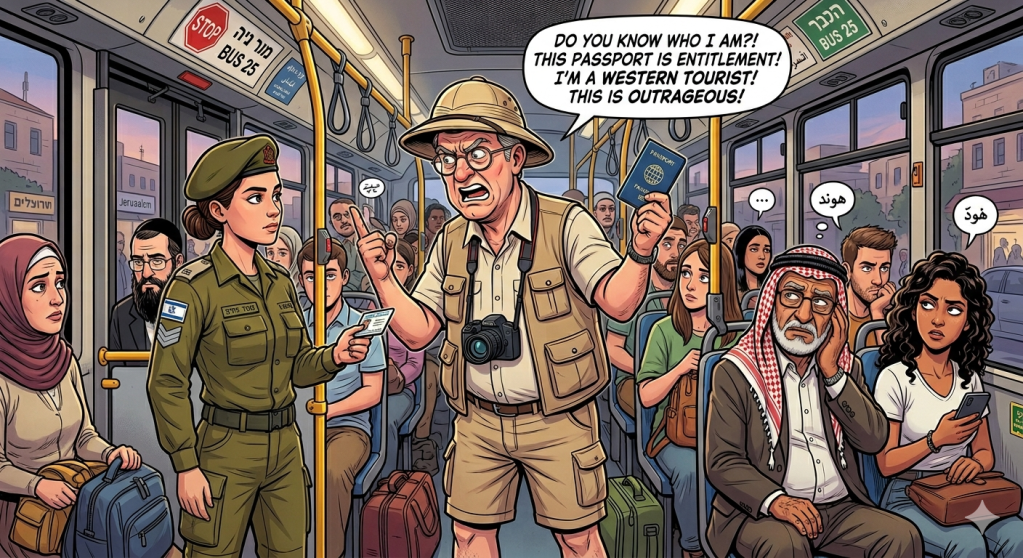
“As an international tourist, I am not subjected to the harassment that most Palestinians face at checkpoints. I am only hindered three times: A soldier boards my bus and demands my ID as I am on my way back to East Jerusalem. On the way to Hebron, I am questioned and searched.”
What is most insufferable about characters like Sheldon is the breathtaking condescension with which they travel the globe—a modern reincarnation of the colonial Herrenmenschenmentalität (master-race mentality). He feels compelled to explicitly emphasize his status as an „international tourist,“ as if his Western passport should automatically exempt him from the basic administrative realities of a conflict zone.
Had he bothered to do even a shred of preliminary research, he would have known that everyone crossing from the West Bank back into Israeli sovereign territory is subject to identity verification and security screening. A border guard is not going to look at him and say, „Ah, everything is clear, Habibi, I see you are an Englishman—no need to check you, have a wonderful journey.“ To frame standard border control on a public transit route as being „hindered“ reveals the staggering entitlement of a vacationer who expects the rest of the world to function as his personal, barrier-free amusement park.
8. The Erotic Phantasms of a Wannabe Adventurer
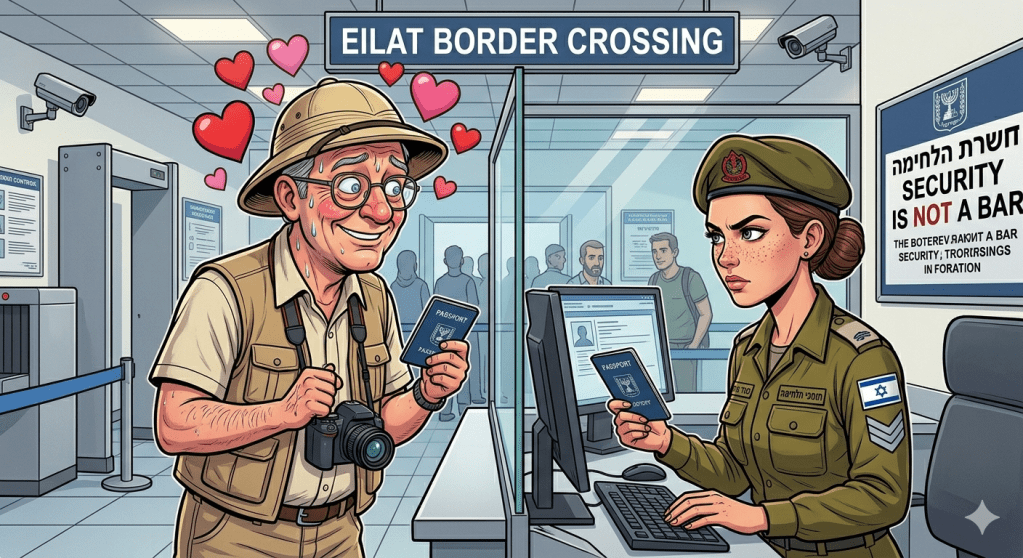
But the true comedic climax of his entire travelogue occurs when he returns to Israel via the Jordanian border at Eilat, leading to a scene that reads like the fever dream of a frustrated, self-absorbed novelist:
“After a week in Jordan, I return to Israel via the border at Eilat. I face a pretty young soldier. She is petite, with freckles on her chubby cheeks. Her hair gleams and her eyes sparkle. ‘You’ve been to Israel before,’ she says. ‘Where were you?’… I feel I have no choice but to tell the truth. ‘The West Bank and Jerusalem,’ I say. There is a pause. And then the interrogation begins: ‘Which cities did you visit? Why did you go there? What did you do? Who did you stay with? Why aren’t you here with your parents? Why on earth do you want to spend time with the Arabs?’ The soldier’s tone is not aggressive. She clearly leads the conversation, but there is a hint of curiosity in her voice. If we were in a bar, I’d say she was flirting.”
Welcome to the ultimate wet dream of a blocked adventurer. In the 19th century, European orientalists traveled to exotic lands dreaming of being seduced by dark-eyed beauties in a harem. In 2015, Joss Sheldon undergoes a standard, highly synchronized security screening at an international border and genuinely convinces himself that the uniform-clad intelligence officer is hitting on him.
The absolute absurdity of this self-delusion is staggering. It never even crosses his narrow mind that these highly specific questions—investigating his itinerary, his contacts, and his motivations—are asked with mathematical precision for a singular purpose: state security. The border official is evaluating his body language, checking his consistency, and assessing whether an unpredictable Western ideological tourist poses a security risk or has been compromised.
Yet, Sheldon’s inflated ego instantly transforms a routine counter-terrorism screening into a romantic bar-room encounter.
9. The Selective Silence of the Authoritarian Tour
What makes this sequence even more telling is Sheldon’s selective memory. He mentions he just spent an entire week in Jordan. Did he cross the kingdom without a single checkpoint? Was he not subjected to the notoriously rigorous questioning of Jordan’s General Intelligence Directorate (GID)?
We can only speculate. Perhaps he got lucky, or perhaps the Jordanian border officials instantly identified him as an eccentric Western simpleton and waved him through as a harmless curiosity. Or perhaps he was subjected to a grueling, highly invasive interrogation by Arab authorities—but chose not to dedicate a single syllable to it in his blog. After all, a thoroughly intense interrogation by Jordanian or Egyptian security forces doesn’t fit the rigid ideological script of his anti-Zionist crusade. If you cannot blame a Jew for the scrutiny, the experience loses all literary and financial market value for Sheldon.
To Be Continued…
Sheldon stands at a legal border post created by the Oslo Accords and diagnoses a human tragedy because an NGO worker had to show her ID, a soldier checked his bus, and a female border guard refused to drop into his lap. The absurdity of his journey deepens as he lays bare his true intentions.
Because as we will see in Part 2, this isn’t about the welfare of the Palestinian people at all. If it were, his „investigative“ passion wouldn’t stop exactly where the Israeli border ends…
 De Republica