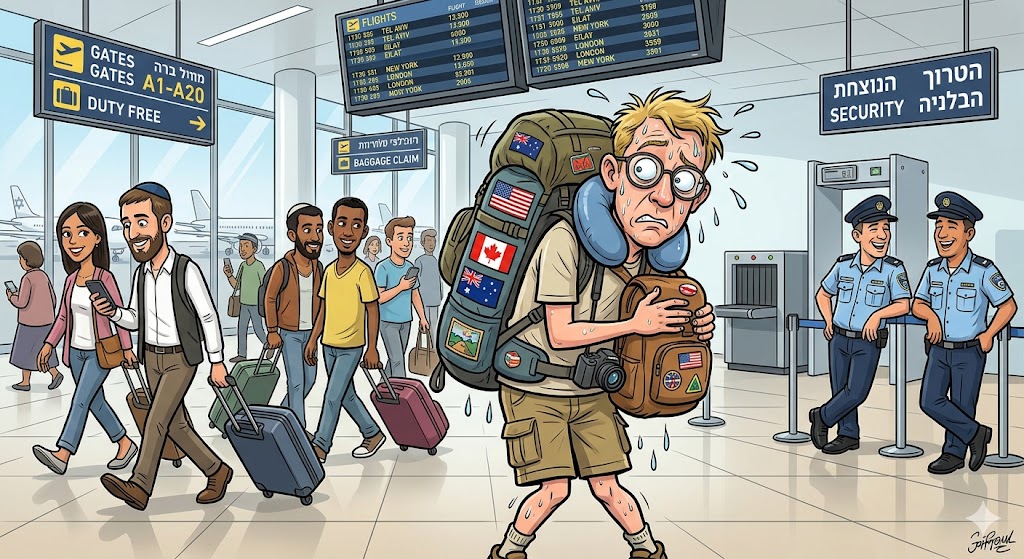
“If you go on a journey, you’ll have something to talk about,” my parents always used to say. And they were right. Though I doubt they anticipated the likes of Joss Sheldon—a self-proclaimed universal genius who, according to his alternative internet bios, „identifies as Jewish.“ Well, I identify as a unicorn without actually being one. In the real world, you either are Jewish or you are not.
But in certain Western salon-anarchist circles, wrapping yourself in a proxy Jewish identity has become quite trendy. Why? Because it serves as the ultimate professional alibi to profit from anti-Semitism and Israel-hatred while claiming moral immunity. Anti-Zionism sells, and Sheldon apparently discovered this lucrative niche around 2015, if not before.
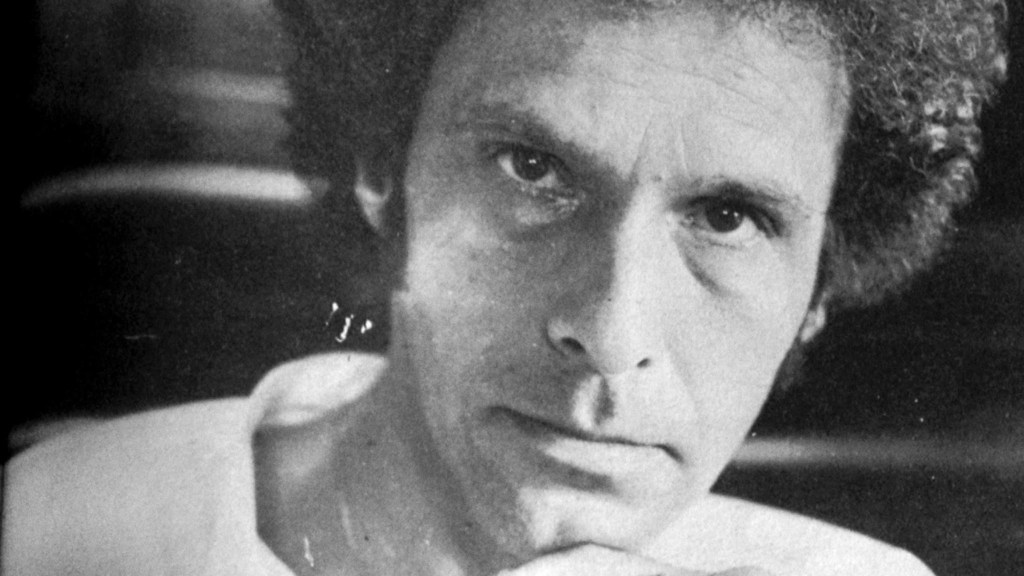
For his book Occupied, he embedded himself „undercover“ in Israel. And once you find yourself in the „eye of the dragon,“ why not milk the experience? If you beg long enough online, portraying Israel as the root of all evil keeps the crowdfunding going—especially when your books aren’t exactly fueling a Hemingway-level legacy.
After reading his travelogue sermon, I picked out a few key passages that completely expose his bias. He is not an objective observer; he is a man with a rigid agenda: to paint Israel in the worst possible light, by any means necessary.
1. The Chomsky Fig Leaf
“The world-renowned scholar and American Jew Noam Chomsky was interviewed by Democracy Now back in 2014 about Israeli ‘apartheid’. He replied as follows:”
What strikes me time and again about these characters is their obsession with weaponizing identity. If Chomsky had been raised in the Voodoo tradition, Sheldon wouldn’t feel the need to mention it. But Chomsky’s heritage is vital here; it serves as Sheldon’s structural shield. It doesn’t matter that Chomsky has spouted enough geopolitical garbage over the decades to fill a library—including his unhinged, mathematically impossible claim that Israel has killed 2 to 3 million Palestinians since 2023. For Sheldon, he is the convenient crown witness.
2. Paranoia at Ben Gurion Airport
“If apartheid isn’t immediately obvious the moment you step into Ben Gurion Airport in Tel Aviv, it is certainly the soldiers who uphold it… They question me as I pass through customs. And I am even surrounded by them whilst waiting to board a bus to Jerusalem.”
Good grief, Joss. If the dog hadn’t stopped to defecate, he’d have caught the rabbit. He seriously claims to diagnose „apartheid“ because armed soldiers are patrolling an airport. What did he expect—the Salvation Army handing out cookies?
The man writes as if he hasn’t set foot in an international hub since 9/11. Walk through Paris-Charles de Gaulle, Brussels, or Heathrow, and you will encounter heavily armed police units dressed in tactical gear carrying Heckler & Koch MP5s. Israel protects its airport—a historical target for international terrorism—just like any other wehrhafte Demokratie. And yes, they questioned you. Anyone standing in a high-security zone looking visibly paranoid, sweating, and actively searching for a fictional „Jews Only“ sign is going to invite a security interview.
3. The Romanticized „Zoo“ and Demographic Blindness
“A soldier sits on a bench, holding his rifle in his lap and stroking it like a mother strokes her baby… An elderly Arab couple keeps their distance… Passengers who look Jewish… walk past us… I feel like I’m making a fool of myself standing here like a statue…”
Here, Sheldon’s diary devolves into a sort of bizarre, voyeuristic prose. He watches a soldier touch a weapon and constructs a psychological drama. He sees an elderly couple keeping their distance—a universal human reaction to armed security at a terminal—and diagnoses systemic oppression.
More tellingly, he claims to instantly differentiate „Jewish-looking“ from „Arab-looking“ passengers. I always wonder how these Western hipsters possess this magical ethno-racial radar. The Nazis literally had to use calipers and phänotypic charts to satisfy their delusions, yet Sheldon does it at a glance while standing „like a statue“ at a bus station.
He completely ignores the demographic reality: Mizrahi Jews—those descended from families ethnically cleansed from Arab and Islamic lands like Yemen, Iraq, and Morocco—make up between 48% and 65% of Israel’s Jewish population. They share the exact same Middle Eastern phänotype. Sheldon is looking at a diverse society through a binary Western lens of „white colonizers,“ completely blind to the fact that he cannot visually tell who is who.
4. The Apartheid Bus Ride
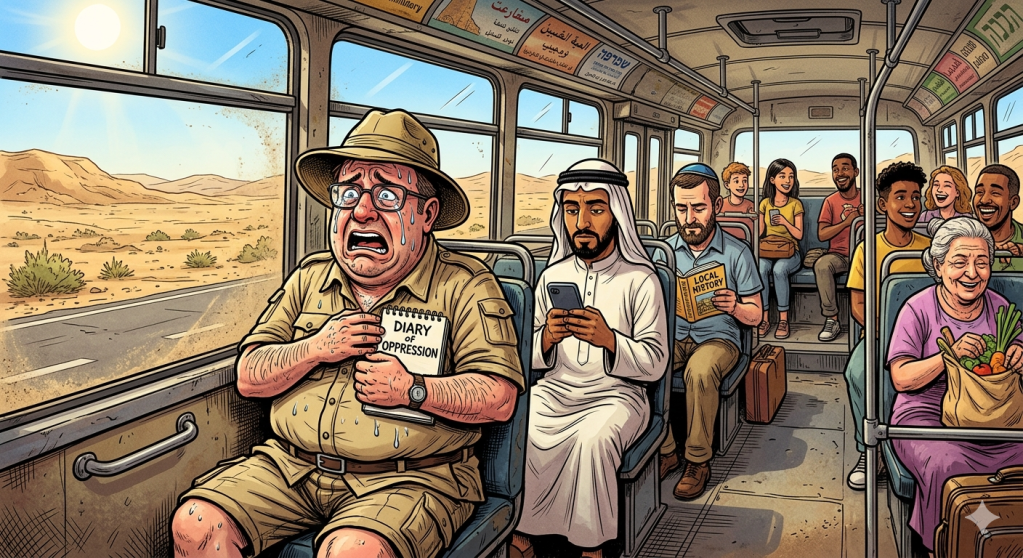
“I board a bus that is fine by most standards, but nowhere near as nice as the intercity coach I travelled on earlier, and set off for the West Bank.”
Ah, yes. Just like South Africa! The regional commuter bus isn’t as luxurious as the long-distance express coach, so it must be racism.
Sheldon treats infrastructure differences as human rights violations. He completely omits the Oslo Accords. The regional transport, infrastructure, and local administration within Areas A and B are the direct responsibility of the Palästinensische Autonomiebehörde (PA) and private Arab transport companies. If the bus is older, it is a reflection of local management, not a Zionist conspiracy. In South Africa, the segregation was codified by law; in Israeli buses, Jews, Muslims, Christians, and Drusen sit side-by-side every single day.
5. The Magic of the Security Barrier
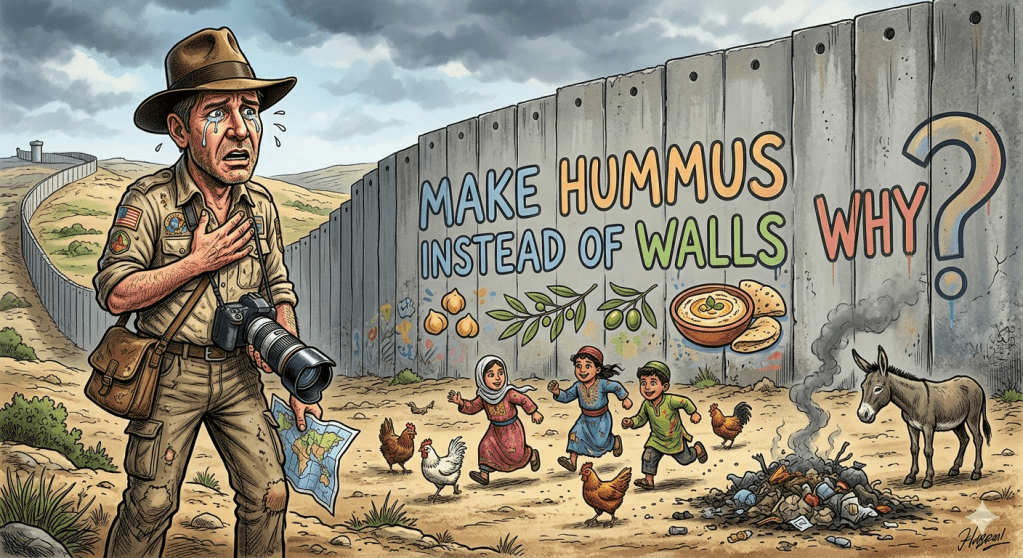
“As I look out of the bus window, the Apartheid Wall comes into view… My heart sinks, but the bus carries on.”
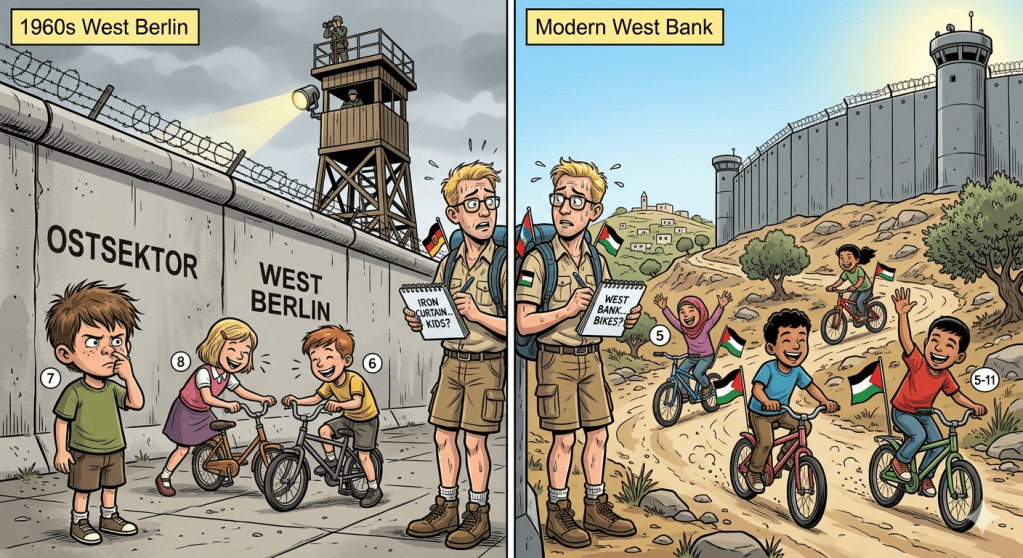
Finally, the grand finale. The cinematic backdrop arrives, and Sheldon gets to play Indiana Jones. The „Wall“—which is actually over 90% a technological wire security fence and only a concrete structure in specific high-risk urban areas—didn’t drop from the sky out of pure malice.
Sheldon conveniently suffers from historical amnesia regarding the Second Intifada. Let us remind him of the empiric reality behind that barrier: During the 1,558 days of the Al-Aqsa Intifada, Israelis faced 20,406 terrorist attacks, including 138 suicide bombings and over 13,000 shooting incidents. 1,036 Israelis were murdered, 715 of them innocent civilians blown to pieces in buses, cafes, and shopping malls. The barrier was built to protect human lives, and it cut suicide bombings by over 90%. Furthermore, Israel’s Supreme Court has repeatedly ordered the military to reroute sections of the fence to accommodate Palestinian humanitarian appeals. Would a true „apartheid state“ allow its supreme judiciary to check its own military to protect the agricultural land of non-citizens?
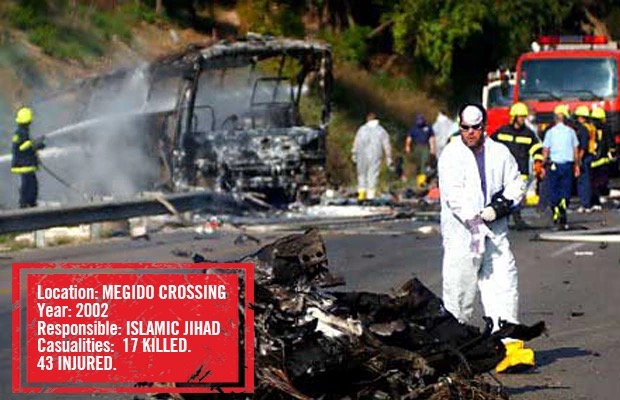
Sheldon should visit Rafah between Egypt and Gaza, or look at the heavily funded EU border barriers in Ceuta and Melilla keeping African migrants out. But those don’t trigger an eleven-part blog series, because no Israelis are involved.
6. The Deep Racism of Post-Colonial Kitsch
“An olive grove nestles against the Wall, full of rampant cacti… A pile of rubbish is burning… Children are chasing chickens… This wall paralyses the economy… All the Palestinians can do is paint.”
This is where the kitsch turns into something much more sinister. Sheldon’s imagery borders on the classic colonial trope of the „noble savage“—archaic, child-like figures chasing chickens in the smoke, whose only agency is painting cute slogans like „Make hummus instead of walls“ on concrete. It reads like Ephraim Kishon’s caricature in Salach Shabati: „Always laughing, always singing, must be mad.“ Or Martha Gellhorn’s 1960s refugee camp dispatches, noting how baufällige huts were described by local leaders as golden marble palaces to Western visitors.
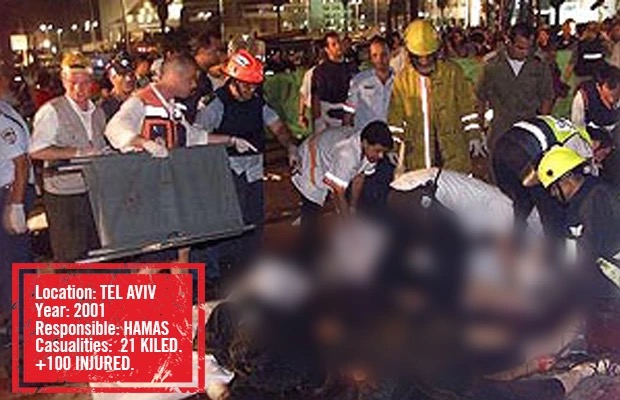
The deep irony is that Sheldon’s post-colonial worldview is inherently racist. By reducing the Palestinians to helpless victims who „can only paint,“ he denies them all political maturity and agency. He completely glosses over the billions in foreign aid poured into the West Bank over decades—far exceeding the Marshall Plan per capita. He ignores the universities, the corporations, and the modern metropolis of Ramallah developed with Western funds. He refuses to hold the PA accountable for its legendary corruption, nepotism, and its „Pay for Slay“ terror-funding system.
In Sheldon’s dogmatic universe, a society can never be broken because its leaders are kleptocrats, religious fanatics, or state-certified autocrats; it can only be broken because the West or the Zionists exist.
To Be Continued…
How utterly fraudulent his entire investigative journey truly is becomes clear when we look at what—and who—he purposefully left out. Because, as we will explore in Part 2, Sheldon doesn’t actually care about the Palestinian people at all. If he did, his research would have taken him to Lebanon or Syria to document the actual, legally codified apartheid and violence Palestinians face under Arab regimes. But those tragedies hold zero market value for him.
After all, a Palestinian life is only worth documenting if a Zionist can be blamed for it.
 De Republica