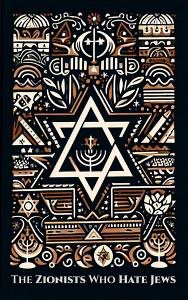
I happened to come across the ‘author’ Joss Sheldon, who, according to his own description, „is ‘a nomad, an unmoored free thinker and a postmodern radical. Born in 1982, he grew up in one of the anonymous suburbs that wrap themselves around the beating heart of London. Then he escaped! With a degree from the London School of Economics, Sheldon sold falafel at music festivals, worked as a ski bum and failed to turn the English Midlands into an oasis of rugby league. Then, in 2013, he set off for McLeod Ganj, an Indian village home to thousands of angry monkeys, hundreds of Tibetan refugees and the Dalai Lama himself. There, Sheldon wrote his debut novel, *Involution & Evolution*. With several positive reviews under his belt, Sheldon was gripped by a writing frenzy. He travelled to Palestine and Kurdistan, where he researched his second novel, “Occupied”, a dystopian masterpiece unlike anything you’ve ever read before. But it was with his third novel, “The Little Voice”, that Sheldon really hit the jackpot; it topped the charts on both sides of the Atlantic and garnered widespread critical acclaim. In 2017, he returned with “Money Power Love”, a love story that explores the rise of the British Empire and how bankers, with their power to create money out of thin air, shaped the world we live in today. Now Sheldon is back with what is arguably his best novel to date, “INDIVIDUTOPIA”. Fans of the novel 1984 will love this dystopian classic, set in a world where corporations have destroyed society and nobody speaks to one another. This is a human story, full of hope, and an adventure in which our heroine does everything she can to escape…“
Now, his books turn out to be anything but a success story, if you look at the reviews and disregard the 5-star ratings; that is the crux of the matter with self-proclaimed authors whose manuscripts no publisher would touch with a barge pole, yet who themselves believe their literary work is comparable to George Orwell’s and think self-publishing will do the trick.
His literary output churns out anything that can somehow make money. Practically a bungler with boundless delusions of grandeur. He has overreached himself, in my view at least, with his book “The Zionists Who Hate the Jews.” To this end, he claims to be Jewish himself, garnishing it with a few Jewish shmontses—he claims to have attended a cheder, for instance.
Millions of anti-Semitic books have now been published across the globe; some are sloppily researched, but they do have one thing in common: they try to be objective, even though you can tell from the imprint alone that an anti-Semite was at work here. Sheldon takes a different approach. He adopts a Jewish identity, claims to have attended a cheder, and demonstrates in his lexicon that it was a complete waste of time.
Anyone who can’t even define correctly what ‘Goy’ means – namely ‘people’, and that ‘Goy Kadosh’ is the term for the people of Israel – could easily have learnt that from the Torah, which is also read in the cheder; they may have seen a few lads outside the cheder, but weren’t actually there. But never mind, if it’s usually ‘sex sells’, then since 7 October ‘anti-Zionism’ sells in large Amounts. There’s something for everyone who blames Israel for all the evil in the world, and since Joss Sheldon admits on Twitter that he would love to see Israel destroyed and wiped off the map, people are already helping out rhetorically by concocting the greatest conspiracy theory since the invention of the tea bag: namely, the alleged anti-Semitism of Zionism.
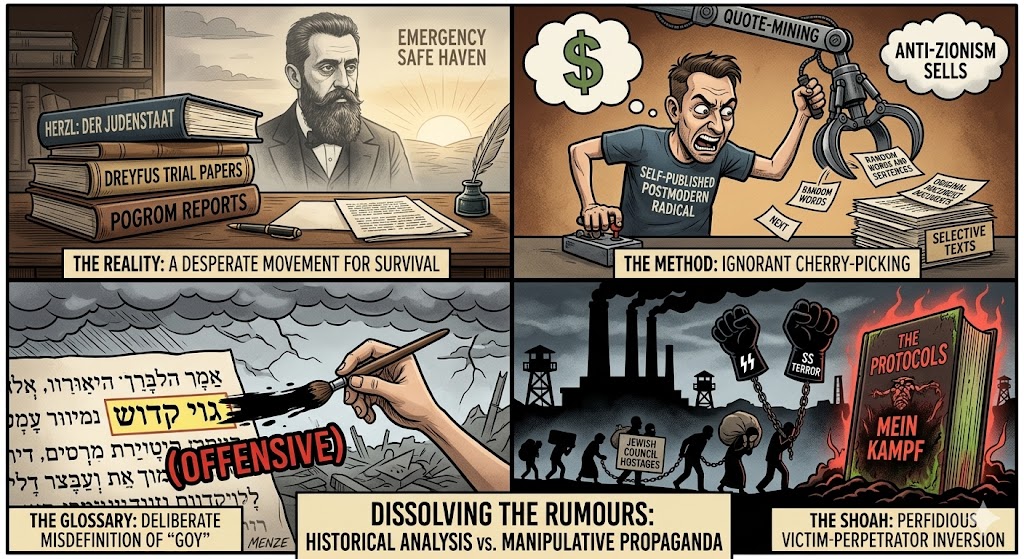
Manipulative quote mining instead of historical analysis
So let’s start with the glossary:
Anyone who has received a sound Jewish education, or who has even begun to engage seriously with the subject, will immediately see that this glossary does not serve to enlighten, but is an ideological propaganda template that relies on half-truths and deliberate misdefinitions.
If one looks at how he defines terms here, his own claims come back to haunt him:
1. The ‘Goy’ declaration of bankruptcy
His definition: “Goy (singular) / Goyim (plural): Anyone who isn’t Jewish. (Offensive).”
- Why this exposes his cheder lie: As we have already established using the real New London Synagogue Cheder, children there learn the basics of the Torah. Anyone who opens the Torah in its original form learns first and foremost that God himself refers to the Jewish people as Goy Kadosh (holy people). A Jewish child is taught there that the Hebrew word simply means ‘people’.
- By mechanically classifying the word as “(offensive)” and translating it bluntly as “non-Jew”, Sheldon adopts, word for word, the anti-Semitic interpretation of the term from the darkest corners of the internet. In doing so, he proves that he never learnt the word from Jewish tradition, but rather from the perspective of an outsider seeking to stoke resentment.
2. The invention of “Arab Jews”
His definition: “Arab Jews: Jewish people of North African and Middle Eastern descent.”
- The historical and cultural reality: The term “Arab Jews” is a modern, primarily anti-Israeli and postcolonial neologism that has been – and continues to be – vehemently rejected almost without exception by those it refers to: the Mizrahim (Oriental Jews) or Sephardic Jews.
- Jews from Iraq, Yemen, Morocco or Egypt have, despite the surrounding Arabic language, never regarded themselves as Arabs, but rather as a distinct, indigenous ethnic-religious community in the Middle East that lived for centuries under dhimmi status (second-class citizens under Islamic rule). Sheldon deliberately uses this term to atomise Jewish identity and force it into modern ethnic categories that are completely at odds with the reality of the Middle East.
3. The manipulative framing: “Jewish Nakba” and the JNF
- “Jewish Nakba”: Here he attempts to linguistically link the expulsion of around 850,000 Jews from the Arab states after 1948 to the Arabic term Nakba (catastrophe). The insidious calculation behind this: he undoubtedly intends to argue later in the book that Zionism is to blame for this fate, because it ‘provoked’ the Arab states. Here, too, the responsibility of the Arab regimes that carried out the pogroms (such as the Farhud he mentions) and expropriations is relativised.
- “JNF (…) acquired Palestinian land”: The definition of the JNF (Keren Kayemeth LeIsrael) is typical clickbait activism. In the late 19th and early 20th centuries, the JNF legally purchased marshland and desert land—often at grossly inflated prices—from mostly Ottoman landowners (effendis) in order to reclaim it. Sheldon uses the modern, politically charged term “Palestinian land” to suggest a scenario of colonial injustice, where in fact there was a legal, private-law property market in the Ottoman Empire at the time.
His introduction is the cherry on top:
1. The ‘us versus them’ framing and the victim role
Right from the very first sentence, Sheldon draws on the classic vocabulary of conspiracy myths: “We’ve been gaslit for far too long.” (We have been manipulated/deceived for far too long).
- He portrays himself and a supposed, silent or censored Jewish minority as the ultimate victims of a colossal, global deception (“ignored, censored, slurred, discredited and forgotten”).
- This ploy serves to immediately give the reader the feeling that they are gaining access to forbidden, suppressed secret knowledge. This is the same psychological template found in almost every classic conspiracy narrative – from flat-earth theories right through to the Protocols.
2. The use of trite cultural clichés
Particularly indicative of his artificially constructed identity is the phrase: “So butter yourself a bagel, make yourself comfortable…”.
- This is exactly the sort of “Jewish shmontses”, it comes across as a cheap, cinematic caricature of Jewish culture, which he sprinkles in here to give the whole thing a superficial, almost cosy veneer of authenticity before unloading the hate-filled content. Someone who has deeply internalised a culture does not use such clichés as an invitation to a pamphlet on the annihilation of human lives.
3. The total accumulation of monstrosities
Sheldon is already firing off the heaviest verbal projectiles here in the foreword, without having provided even a shred of evidence:
- Zionists have “made a pact with the greatest Jew-haters on the planet”.
- They have “prayed for a divine Armageddon that would claim millions of Jewish lives”.
- They are said to have “provoked the ethnic cleansing of several Jewish communities”.
- They are said to have “used Jews as human shields”.
By simply throwing these wildly escalated claims out there, he attempts to establish the moral judgement in the reader’s mind before they even begin reading the chapters. This is not about historical deduction, but about emotional prejudgement.
4. The shameless announcement: “A journey of shame”
When he writes that the reader should prepare for a “journey of shame”, he openly admits what the book’s actual aim is: it is not about historical insight, about understanding the hardships, powerlessness or geopolitical constraints of the 19th and 20th centuries. It is about the deliberate belittling, humiliation and delegitimisation of a national movement and the State of Israel.
CHAPTER TWO
Having discovered what these Zionists believed, we’ll take a look at what they did: We’ll see how Herzl traipsed around Europe, courting leaders such as Kaiser Wilhelm (who believed Jews “want stamping out”), and Vyacheslav von Plehve (who was responsible for the pogroms in Imperial Russia). We’ll see how his protégés went cap in hand to Lord Balfour (who agreed with several “anti-Semitic postulates”), and Winston Churchill (who described Jews as “extraordinary personalities from the underworld”).
Israel’s first prime minister, David Ben-Gurion, put a positive spin on the Nazis’ persecution of Jews – saying: “The harsher the affliction, the greater the strength of Zionism”. And Israel’s first president, Chaim Weizmann, dismissed the Nazis’ victims – saying those who will be “destroyed will be destroyed”.
Zionists in the Yishuv traded with Nazi Germany, breaking the international boycott of that malevolent regime. Zionists in the West campaigned against missions which could’ve saved Jews from obliteration. Others censored information about the Shoah, which could’ve been used to save hundreds-of-thousands of Jewish lives […]“ The ZIONISTS who HATE JEWS
This is essentially a summary of the entire conspiracy theory agenda that Sheldon intends to spell out in the following chapters. In this transition from Chapter One to Chapter Two, he once again distils his method of total historical decontextualisation and exaggerated polemic into a malicious ‘indictment’.When one considers how he reinterprets the diplomatic efforts of the Zionist leadership in the late 19th and early 20th centuries, the fundamental historical distortion is glaringly obvious:
1. The absurd argument of “courting” anti-Semites
Sheldon accuses Herzl of having travelled through Europe to negotiate with anti-Semites such as Kaiser Wilhelm II or the Russian Minister of the Interior, Vyacheslav von Plehve.
- The historical reality: This was not a display of sympathy, but the painful, realpolitik diplomacy of absolute powerlessness. When one represents a stateless people persecuted worldwide and is desperately seeking ways to escape persecution and pogroms, one must negotiate with those who held power in Europe at the time.
- Herzl met Plehve immediately after the terrible pogrom in Kishinev (1903). His intention was not to ‘curry favour’ with this man, but to pragmatically persuade him to facilitate Jewish emigration from the repressive Tsarist Empire, both legally and logistically. Sheldon twists this desperate diplomatic emergency measure into moral complicity.
2. The continued distortion of Ben-Gurion and Weizmann
Here, Sheldon repeats his extremely distorted claims about Ben-Gurion and Chaim Weizmann once again, in order to anchor them deep in the reader’s memory:
- The Weizmann quote (“destroyed will be destroyed”) is presented here in such an abbreviated form as to suggest he had dismissed the victims of the Nazis with a shrug. In fact, Weizmann’s contemporary remarks during the Second World War reflect sheer, traumatic horror at the systematic extermination, against which the Yishuv had virtually no military recourse due to its geopolitical isolation and restrictive British policies.
3. The Silencing of Jewish Self-Assertion
By claiming that the Zionists demanded “disobedience to Jewish scripture”, Sheldon plays into the age-old, internal Jewish (and often externally exploited) theological dispute between traditionalists and secular national movements. Zionism was an emancipatory, primarily secular movement that sought to transform the fate of the Jews from passive expectation of the Messiah into their own active political agency. Sheldon reinterprets this act of modern self-assertion as a malicious sin.
Since the rest of this pamphlet isn’t any better, I’d still like to highlight a few points that back up my argument: ignorance meets delusions of grandeur in the most negative sense.
On Twitter, he labels anyone who contradicts his crude logic with facts as an anti-Semite. Sheldon has no idea about the texts; he has never read them. As I have Herzl’s edition here and have read it, I know that if one looks into Zionism, one sees what Zionism was: a movement to save the Jews.
Anyone who has read and understood Herzl’s The Jewish State knows what the situation of European Jews was like between 1800 and 1900. The pogroms against Jews in Eastern Europe, the trial of Alfred Dreyfus, which Herzl had reported on and from which he concluded that no matter how hard the Jews tried to be accepted, marrying non-Jewish women and converting to Christianity in droves, they would never be accepted as equals.
A lesson that thousands of half-Jews had to learn the hard way under the Nuremberg Race Laws of 1935. Sheldon brushes this aside in his diabolical intent to portray Zionism as the ultimate evil, through his cherry-picking and deliberate falsification of quotations and lies.
People who hate Jews will eagerly snap up the book, as it caters to all the motives of religiously motivated and ‘openly eliminatory anti-Semitism’ involving pogroms and the extermination of Jews.„THE ZIONISTS WHO FACILITATED THE SHOAH
The Zionists who censored news of the Holocaust were complicit in the murders of millions of Jews. Their actions were so nefarious, they deserve a section of their own.
But they weren’t the only Zionists who were implicated in the Shoah.
Chajka Klinger was a member of the Jewish Fighting Organization, a group that resisted the Nazis in Poland. She was scathing of the entire Zionist leadership, calling them “tools of suppression”:
“Jewish communities were headed by members of the Zionist movement… (They) began assisting the Nazis to collect gold and furniture from Jewish homes… (After that), they had no choice but to go on to help them prepare lists of Jews for (the) labour camps… One bright day, we will need to try these people. It must be said clearly and publicly that many Zionists betrayed (us)”. (Porat, 2019).
So, who were these people who’d been “assisting the Nazis” – pillaging Jewish homes, and rounding up their Jewish peers?
Collectively, they were known as the Judenräte – the “Jewish Councils”.
They weren’t exclusively Zionist, and most Zionists had no connection with them whatsoever. But a few of their leaders were “members of “
The ZIONISTS who HATE JEWS
Their actions were so nefarious, they deserve a section of their own.
But they weren’t the only Zionists who were implicated in the Shoah.
Chajka Klinger was a member of the Jewish Fighting Organization, a group that resisted the Nazis in Poland. She was scathing of the entire Zionist leadership, calling them “tools of suppression”:
“Jewish communities were headed by members of the Zionist movement… (They) began assisting the Nazis to collect gold and furniture from Jewish homes… (After that), they had no choice but to go on to help them prepare lists of Jews for (the) labour camps… One bright day, we will need to try these people. It must be said clearly and publicly that many Zionists betrayed (us)”. (Porat, 2019).
So, who were these people who’d been “assisting the Nazis” – pillaging Jewish homes, and rounding up their Jewish peers?
Collectively, they were known as the Judenräte – the “Jewish Councils”.
They weren’t exclusively Zionist, and most Zionists had no connection with them whatsoever. But a few of their leaders were “members of the Zionist movement”, as Klinger explained. And these deserve a mention…
Let’s begin with the Sosnowiec Judenrat, which was led by Moses Merin – a […]“
The ZIONISTS who HATE JEWS
Here, Sheldon crosses the line from mere sloppy sourcing into active, malicious Shoah trivialisation and the reversal of perpetrator and victim.
The phenomenon of the Jewish Councils and the traumatic debates within the Jewish ghetto resistance movements are among the most painful and complex chapters in the entire history of humanity. Sheldon takes this incomprehensible tragedy, strips it of any context of absolute terror, total powerlessness and psychological torture at the hands of the SS, and exploits it for the cheapest anti-Israeli propaganda.
If one deconstructs this passage, one sees the sheer malice of his method:
1. The deliberate misinterpretation of Chaika Klinger’s despair
Sheldon quotes Chaika Klinger, a real, courageous resistance fighter in the HaShomer HaTzair (a left-wing Zionist youth movement!) and a member of the Jewish Combat Organisation (ZOB) in Będzin and Sosnowiec. He uses her diaries
(Porat, 2019 – referring to the biography by Dina Porat)to construct a Zionist complicity in the Shoah.
- The historical reality: The conflict in the ghettos (particularly in Sosnowiec/Będzin under the brutal rule of Moniek (Moses) Merin) was a conflict of generations and strategies, not an ideological conflict between Zionism and non-Zionism. From 1942/43 onwards, the young resistance fighters (almost all of whom came from Zionistyouth organisations!) realised that the strategy of the older Jewish Councils (“salvation through work”, i.e. cooperation in the hope that the Germans would spare productive workers) had failed and was leading to extermination. They called for armed resistance.
- Klinger condemned those officials who had been active in Zionist organisations before the war and now sat on the Jewish Council, because she regarded their policy of accommodation as a betrayal of the Jewish people and of the very ideals of Zionism.
- Sheldon’s distortion: Sheldon turns this on its head. He fails to mention that Chaika Klinger herself was a fervent Zionist and that the armed resistance in the ghetto was largely carried out by Zionists (such as Mordechai Anielewicz in the Warsaw Ghetto). He presents it as though Zionism had been the cause of the Jewish Councils’ behaviour.
2. The decontextualisation of the “Jewish Councils”
The Jewish Councils were not voluntary associations or ‘alliances’. They were forcibly installed by the German occupying power under threat of immediate death.
- The SS forced these councils to carry out the occupiers’ orders – from the distribution of food in the ghetto to the collection of levies and the horrific compilation of deportation lists. The Nazis’ strategy was one of perfidious cruelty: they sought to corrupt Jewish self-government, psychologically divide the victims, and delegate the administrative dirty work of extermination to the hostages themselves.
- Figures such as Moses Merin in Sosnowiec or Chaim Rumkowski in Łódź operated in an absolutely hopeless extreme situation. Many of them mistakenly believed until the very end that by sacrificing parts of the population (e.g. the elderly and the sick), they could save the rest of the community until the Red Army arrived. They all failed and, almost without exception, were themselves gassed by the Nazis in Auschwitz in the end.
3. The moral crime of Sheldon’s narrative
When Sheldon writes: “The Zionists who censored news of the Holocaust were complicit in the murders of millions of Jews”, he is engaging in the dirtiest business of Holocaust denial and relativisation.
He shifts the historical blame and agency:
- It is not the Nazis, who built the gas chambers, starved the ghettos and systematically exterminated the entire European Jewish population, who are the focus of his accusation here – but the Jewish victims themselves, who, in a state of total isolation, deception by German propaganda and sheer fear of death, attempted to negotiate the survival of individual lives.
- To claim that a Jewish movement “facilitated” the Shoah is the absolute height of secondary anti-Semitism.
Conclusion: This is not the work of a historian, but of an apologist for the Third Reich. If Joseph Goebbels were still alive, he would be moved to tears by Joss Sheldon. “The Zionists Who Hate Jews” serves as a modern blueprint for “The Protocols of the Elders of Zion” and Hitler’s “Mein Kampf”, drawing seamlessly on the very same antisemitic clichés that have circulated in Europe for centuries and ultimately made the Holocaust possible.
As Theodor W. Adorno famously stated in a 1962 lecture: “Antisemitism is not an opinion, but an affect; it cannot therefore be combated with arguments, but only with authority or violence.” What Sheldon has produced is nothing more than a modern iteration of what Adorno and Max Horkheimer coined in “Dialectic of Enlightenment” as “The Rumour about the Jews” (Das Gerücht über die Juden). It is a closed system of projection, devoid of historical truth, designed for a single purpose: the moral and physical elimination of the Jewish collective.

